
Amphibians and reptiles
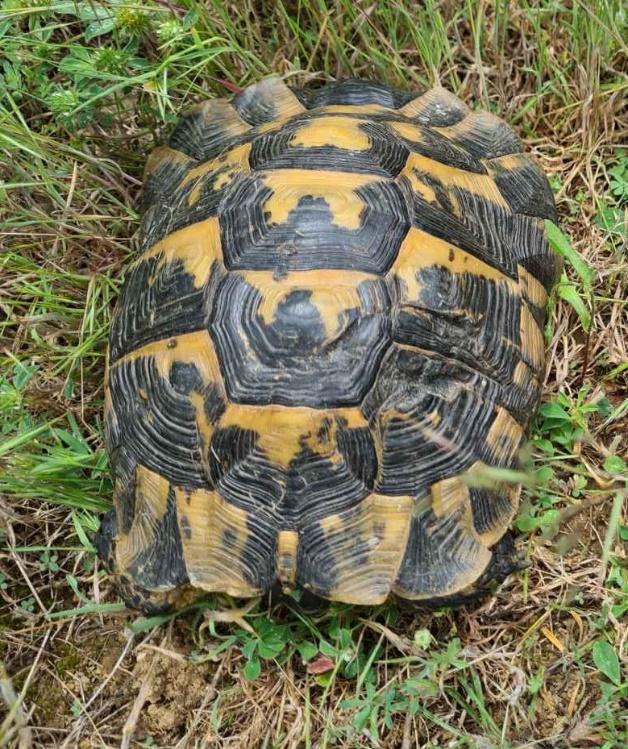
Testudo graeca
Testudo graeca
Occurs almost throughout the country except its northwestern parts; single individuals transferred from other places can be found there. In the mountains of southwestern Bulgaria it is found up to about 1300 m above sea level. The density of the populations is strongly influenced by human activity. In large areas in the most flat parts of the country they have been completely destroyed, in others small fragmented populations remain. There are relatively better preserved populations in Strandzha, the Eastern Rhodopes and at the foot of the mountains around the Petrich-Sandanski valley.
Current populations inhabit mainly lowland and hilly areas overgrown with shrubs and low-stemmed forests. Open grassy spaces are preferred among them.
In May-July it lays 2 or 3 times 2 to 8 almost globular eggs, which it burrows into holes in the soil. The eggs hatch after 70-100 days. Puberty occurs at 11-14 years of age. The largest and probably the oldest land turtles of both species have been found in Bulgaria. It feeds mainly on grasses, fallen fruits, etc.
Factors that negatively affect the species are human agricultural activity, especially in recent decades (creation of consolidated blocks, irrigation systems, tillage). Elimination of micro-relief forms, destruction of lowland forests, collection for food from certain groups of the population and for "treatment", despite the proven futility of this. The construction of highways, gas pipelines, etc., the construction of the Black Sea coast, forest fires (especially in Southeastern Bulgaria), the replacement of deciduous forests with coniferous ones also have a negative impact.
Found on the Mediterranean shores of Europe and many of the Mediterranean islands; to the east - to western Iran, Syria and northern Iraq. It is also found on the north coast of Africa. It is widespread in the southeastern half of the Balkans.
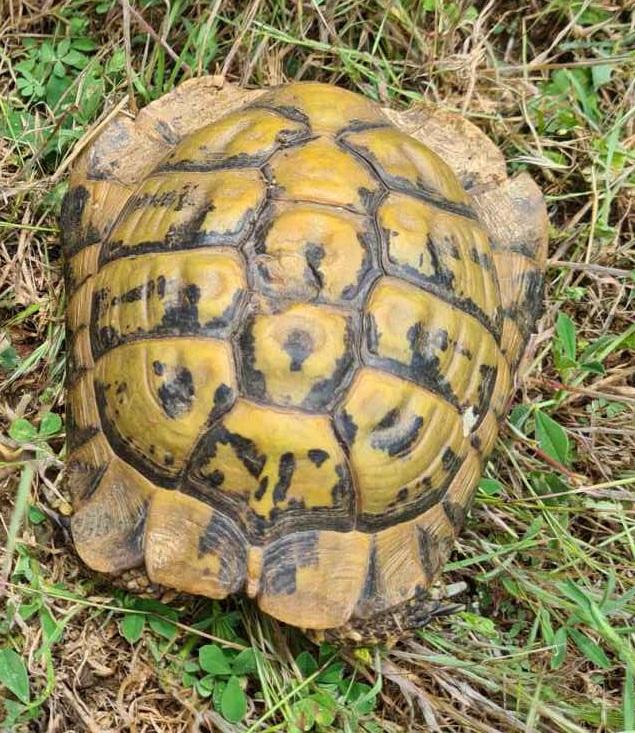
Testudo hermanni
Testudo hermanni
Occurs throughout the country except its northeastern part. In the mountains of southwestern Bulgaria it is found up to about 1450 m above sea level. The number is strongly influenced by human activity. In 1980–2006, highly fragmented, endangered populations of both species of tortoises were found in a mosaic of about 40% of the country's territory. In about 30% the turtles are completely extinct, in about 20% (high mountain areas) they have never been and only in about 10% the populations are in relatively good condition - mainly at the foot of the mountains in southwestern Bulgaria, the Eastern Rhodopes, Sakar and Sakar. Strandzha.
Its habitats are lowland and hilly areas, most often overgrown with sparse forests and shrubs.
Lays 2–5 elongated eggs two or three times a year. The young hatch after 90-120 days. It feeds mainly on plant foods. Terrestrial turtles overwinter in loose soil, usually on southern slopes, burying to a depth of several tens of centimeters.
Negative factors on the species are human agricultural activity, especially in recent decades (creation of consolidated blocks, irrigation systems, tillage). Elimination of the forms of the microrelief, the destruction of the plain forests; collection for food from the population and for "treatment", despite the proven futility of it. Large infrastructure constructions (highways, gas pipelines, etc.), the construction of the Black Sea coast, forest fires (especially in southeastern Bulgaria), the replacement of deciduous forests with coniferous ones also have a negative impact. In the lowlands of Berkovitsa, Chiprovtsi and Belogradchik, wild boars often feed on young and young individuals.
Occurs in southern Europe, from the northeast coast of Spain to the Bosphorus and many of the Mediterranean islands. On the Balkan Peninsula it is absent from large areas in Croatia, Bosnia, Serbia and Bulgarian Dobrudja; with single populations in Romanian Dobrogea. North of the Danube it is found in a small area northeast of the Iron Gate.

Triturus karelinii

Triturus karelinii
The newt lives in and around mountain forests. These forests are quite variable in the composition of tree species and include deciduous and coniferous species. The newt is also found in the forest steppe and real steppe places in the mountains, as most of these populations are relict fauna from former forest habitats. Within these landscapes, newt populations inhabit slopes and plateaus covered with meadows or xerophytic vegetation that contain small, stagnant swamps and lakes. Such habitats are widespread, for example in parts of the species' range in Crimea and southern Azerbaijan. Breeding occurs in swamps and lakes of different sizes.
The activity is mostly night. Hibernation usually occurs from September or October to March. In unusually warm winters, the end of hibernation can be postponed to the end of January - February. The species hibernates on land, but in many cases in deep stagnant waters. Breeding takes place in March - May. In the highlands this period shifts to May - July. On the other hand, in low altitudes and warm winters, the breeding of newts begins earlier, in February. Embryonic development takes about 10-12 days. The spawning period within a pond is long. The species is quite vulnerable to the seasonal increase in water eutrophication. Metamorphosis occurs from August to October, but in some cases the larvae overwinter and complete their development the following year. Sexual maturity is reached at 5-6 years. The maximum life expectancy is estimated at 10-15 years.
Immediately after switching to active feeding, the larvae mainly eat creeping micro-crustaceans and small amounts of pelagic and benthic forms. In the process of individual development, the share of mollusks, insects and large planktonic micro-crustaceans increases, while small-creeping micro-crustaceans decrease. Newly metamorphosed specimens on land consume snails, mites, carbides and caterpillars. Aquatic adult food consists of limnophilous organisms (adapted to living in stagnant water). Aquatic adults also eat some terrestrial invertebrates, probably those that have fallen into the water. Earth adults consume worms, snails, spiders and insects.
The main threat to the species is deforestation and water pollution.
Triturus karelinii inhabits the eastern part of the Balkan Peninsula, Crimea, Asia Minor, the Caucasus and northern Iran. From west to east he lives from Serbia to the west coast of the Black Sea, then over its southern coast from western Turkey to northern Iran (the Elburz Mountains). In Crimea he lives only in the Crimean mountains on the southern coast of the peninsula. In the system of the Main Caucasus Range, the northern boundary of the species' range runs along the northern macroslope of the Main Caucasus Range in Russia.
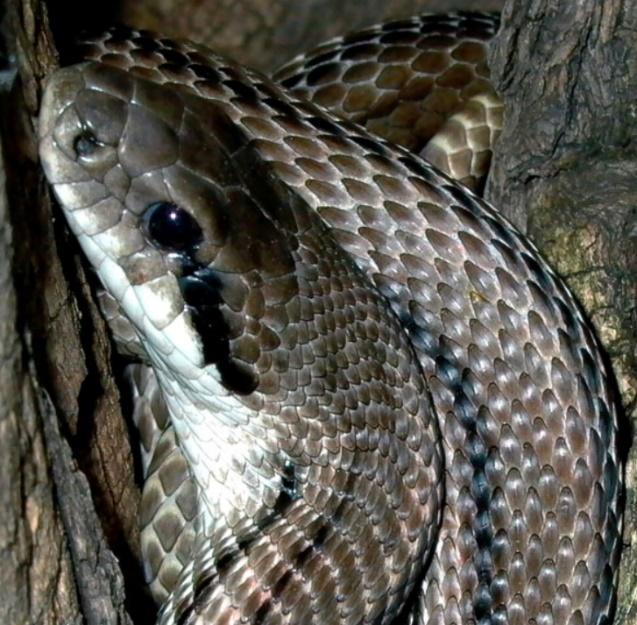
Elaphe quatuorlineata
Elaphe quatuorlineata
It is found only in the Petrich-Sandanski valley, the valley of the Strumeshnitsa river and the southern half of the Kresna gorge. In the plains of the Petrich-Sandanski valley it was almost destroyed due to the large share of arable land and remained mainly at the foot of the surrounding mountains and some island-located rocky hills. Up to 600 m above sea level it has been found in the Kresna Gorge. The number and density of the populations are unknown.
Its habitats are mainly low-stemmed forests and shrubs in rocky and other places with well-developed microrelief, on sunlit slopes.
In the second half of June-beginning of July it lays 5-14 eggs. It feeds mainly on birds and their eggs, less often on rodents, and sometimes swallows newborn bunnies, hedgehogs and newly hatched tortoises. Reaches 180, rarely 200 cm in length. It is not poisonous.
The factors that affect him negatively are the intensive agriculture in the Petrich-Sandanski valley. Extermination by the local population, poaching by collectors and terrorists, trampling on the roads.
Occurs in Italy, the entire west coast of the Balkans, the western half of Greece and many of the Greek islands, Macedonia and the southwest corner of Bulgaria.