
Bats
Rhinolophus ferrumequinum
The Great Horseshoe Bat is the largest horseshoe bat in Europe. It is light gray-brown in color, slightly darker on the back, and its wings are dark brown.
The large horseshoe bat inhabits caves, rock niches, hollows, abandoned buildings and other covered places with a relatively large entrance and volume. It is especially common in karst areas. He hibernates with a sharp drop in body temperature, and the temperature in his winter shelters must be at least 4 ° C. Life expectancy is up to 30 years. Stationary type, performing only local seasonal migrations at a distance of up to 50 km. Lives in summer (breeding) and winter colonies. It often coexists with other bat species, such as the Rhinolopus euryale and the Myotis emarginatus.
For orientation, the species uses echolocation, emitting an ultrasonic signal. It flies relatively slowly, but is very maneuverable. It feeds mainly on large insects, which it usually catches in flight. Its favorite food is moths, but in spring and autumn, when they are less common, it also feeds on other species of butterflies, beetles, beetles and biplanes.
Large horseshoe bats reach sexual maturity in their third year, and even then females do not participate in reproduction every year. Copulation is usually in autumn, less often in winter or spring. As with most bats found in Europe, fertilization occurs only in the spring. In May-June summer colonies are formed, composed almost entirely of females, and in late June and early July they give birth to one. The young learn to fly after 35-40 days and by the beginning of September they are relocating, as the summer colonies disintegrate.
Distributed in much of Europe (from southern England to the Caucasus), central Asia (northern Iran, the Himalayas and northern Japan) and northwestern Africa. In Bulgaria it is found throughout the country, rarely at altitudes above 1600 m.
Rhinolophus hipposideros
The small horseshoe bat is one of the smallest bats found in Bulgaria. The color of the back varies from dull yellow to smoky brown. The abdomen is grayish to grayish white. The wings are light brown-gray. Young individuals are dark gray.
Inhabits caves, basements, ceilings and other parts of buildings, mining galleries. It winters in underground shelters, such as caves, galleries and basements. Lives alone, in pairs or in colonies of up to 40 specimens. In winter it does not form colonies, like other horseshoe bats. It takes off immediately after sunset, but sometimes there is daily activity. It hibernates from September to October, at a temperature of 6-9 ° C (in Europe). It wakes up in the period March - April, depending on the temperature. Leads a sedentary lifestyle - flies a maximum of 10 km between summer and winter refuges. It feeds on mosquitoes, moths, small moths, beetles and rarely spiders. It hunts mainly in forests, city parks and gardens, less often over meadows and pastures and riparian forests. Sometimes it catches prey from stones and branches.
The female gives birth in June-July to a baby, which she sees after about a week, and is separated from the mother after 6-8 weeks. Sexual maturity reaches 1-3 years. He lives to be over 20 years old.
Among the main threats to the species in the country are the closure of caves and galleries; the demolition of buildings and man-made structures; anxiety in caves due to cavemanship and visits to caves for recreation. Intensification of agriculture, the use of biocides, hormones and chemicals, the removal of forest undergrowth, the use of biocides, hormones and chemicals (in forestry), and groundwater pollution also have a negative impact.
The species reaches the northernmost distribution of horseshoe bats. It is distributed from Ireland, the Iberian Peninsula and Morocco, through southern Europe and North Africa to Kyrgyzstan and Kashmir, the Arabian Peninsula, Sudan and Ethiopia. In Bulgaria it is found throughout the country and in the mountains it reaches 1500 m above sea level
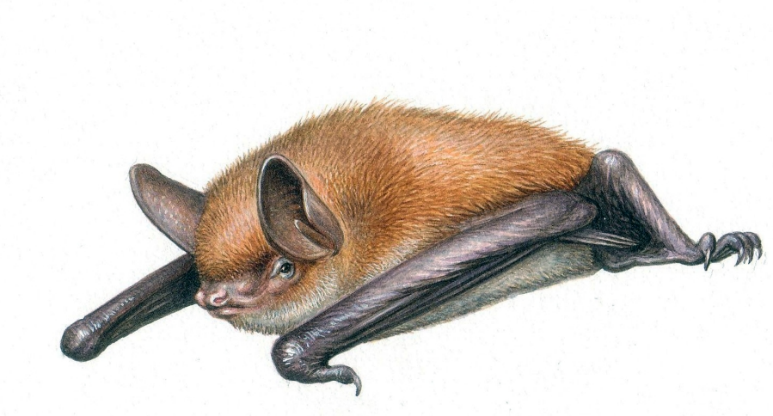
Myotis myotis
Myotis myotis
One of our biggest bats. The color of the coat is gray-brown above and light gray below. The wings are wide, the membrane is dark gray. The ears are wide and oval. Forms numerous, noisy, summer colonies in caves.
The species inhabits sparse forests, parks, meadows. The flight of this bat is relatively slow and maneuverable at a height of 5 - 8 m. It feeds in open places in sparse forests and their outskirts, where the ground is covered with fallen leaves and some grass. It catches its victims in flight or collects them from various surfaces - most often from the ground. In summer it inhabits caves, rarely dark parts of buildings, hollows of trees. Winters in caves, mining galleries, etc., choosing places with high humidity and temperatures in the range of 7-12 ° C. It usually hangs freely on the ceilings of caves. It carries out regular migrations between summer and winter shelters (sometimes over 200 km), using a number of temporary intermediate shelters. It feeds on large insects that it catches in flight (eg moths) or collects from the ground (beetles, crickets, etc.)
Copulation is mainly in autumn, less often in spring. Females visit males. Usually one male attracts 4-5 females. Pregnancy is 50-60 days. During the summer, the males live mostly alone, and the females form colonies, where they give birth and raise the young. These breeding colonies are found in small, dry and ventilated caves or in the entrance parts of larger caves, often mixed with other cave bat species. The number of colonies can reach several thousand females. The female gives birth at the end of May - beginning of June to a naked and blind little one. The young are usually born early in the morning. The next night, the mothers left them in small groups with several females to go hunting. The baby begins to fly after 40-50 days, and becomes independent after 2 months. Females reach sexual maturity at 3 months of age and males at 15 months. The maximum life expectancy is over 25 years, but most often about 5 years.
Among the most serious threats to the species are cave disturbances due to caving, visits to recreational caves, vandalism, closure of caves or galleries, demolition of buildings and man-made structures. Intensification of agriculture is also important for the species; the use of biocides, hormones and chemicals; removal of forest undergrowth, pollution of groundwater.
Occurs in Southern, Central and Eastern Europe, relatively rare in Northern and Western Europe, Asia Minor, Lebanon, Israel. In Bulgaria it is found in karst areas throughout the country - one of the most common cave species. In the Western and Central Stara Planina it is found up to 1400 m above sea level, and in Pirin - at 2500 m above sea level
Myotis emarginatus

Myotis emarginatus
This species is a typical inhabitant of the lowland karst areas. He settled in caves, abandoned buildings, old military bunkers and more. Thermophilic type. The temperature in the breeding grounds can reach 35 ° С.
Breeding colonies consist mainly of females, most often mixed with horseshoes. Before mid-August, soon after all the young could fly, the colony left the shelter and settled in another shelter near or far. It feeds mainly on spiders, flies, web beetles and less often butterflies. During the winter in our country only single individuals have been found in caves. Due to their high numbers, the populations of the Balkan Peninsula are considered an important genetic reserve for the species.
Negative factors on the species are disturbance during the breeding season (June-July), expulsion and lack of alternative shelter in the same area, where the colonies fall apart and breeding success is almost zero, overgrowth or collapse of shelter entrances leads to their temporary or permanent abandonment.
The species inhabits Central and Southern Europe, north to southern Poland and the Netherlands, east to Afghanistan, eastern Iran and Uzbekistan. Morocco, Algeria, Tunisia and Lebanon. There are 73 known deposits in Bulgaria, located throughout the country, 31 of which were reported before 1985. Most shelters and colonies have been established in the low mountain belt (up to 400-500 m above sea level). Single individuals have been registered up to about 1600 m above sea level in the Central Stara Planina, 1550 m above sea level in Rila, 1560 m above sea level in the Western Rhodopes.
Myotis bechsteinii

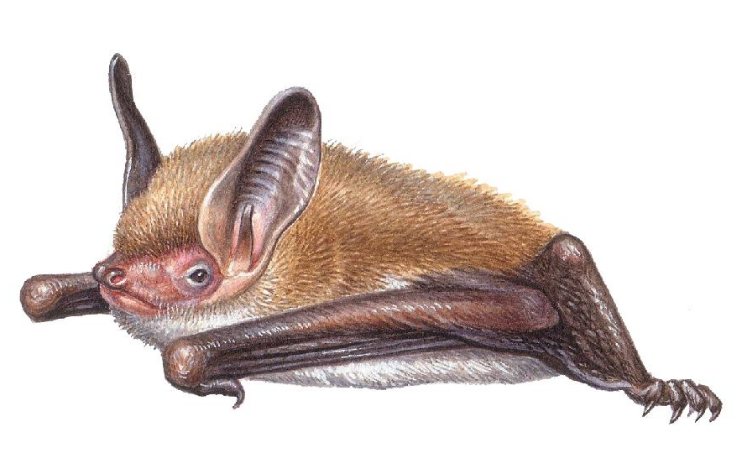
Myotis bechsteinii
The species is a typical inhabitant of the old deciduous forests. Its number is highest in mesophilic forests with a permanent reservoir. Single individuals live in tree hollows with a stem diameter of 13–20 cm at a height of 0.7–5 m from the ground. Colonies have been found only in older trees 40–55 cm in diameter and 5–12 m high.
Males usually live alone, and females - in small groups (5-10 individuals) or colonies (10-30 individuals). Females are extremely attached to the area of the hollow where they were born. Stationary species that rarely performs larger migrations (up to 60 km). In June she gives birth to 1 baby, which breastfeeds for about 3 weeks. From late August to late September, Bechstein nightgowns (about 90% male, 10% female) congregate at the entrances of caves or abandoned mining galleries in order to find partners.
A negative factor on the species is the selective felling of old and hollow trees, which reduces the possibilities for finding suitable shelters, as well as the fragmentation of compact forest habitats and the severance of connections between them.
The species is found in Europe, north to southern Sweden, east - to the Caucasus, Azerbaijan and northern Iran. In Bulgaria the highest density is between 1000 m and 1400 m, in areas with extensive and compact forests (Central Balkans, Western Rhodopes, Strandzha). It is rare in the Danube plain, it is missing in the open parts of Thrace.
Barbastella barbastellus

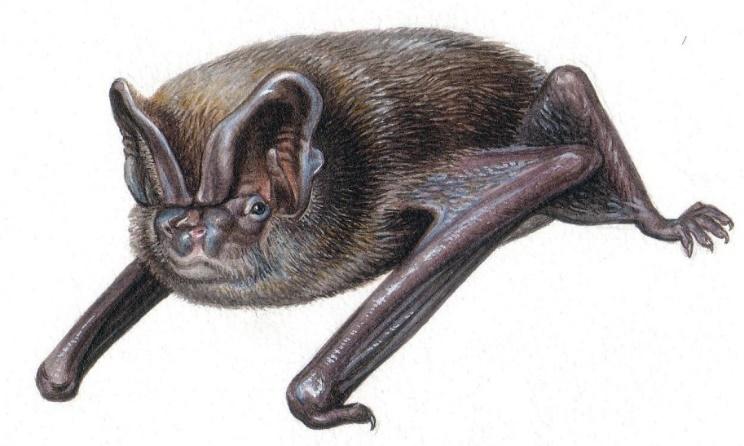
Barbastella barbastellus
The species prefers humid forest habitats in the middle mountain belt (700–1400 m above sea level). During the winter it is found individually or in groups of up to 30 individuals in the coldest, entrance parts of the caves at temperatures around 0–2 ° С. During the summer months, it lives almost exclusively in tree hollows and less frequently in other shelters (such as crevices in rocks). Performs local migrations that rarely exceed 50 km. There are no data on the food spectrum in Bulgaria. In Central Europe it feeds on small moths and flies.
Negative factors on the species are the felling of old and hollow trees, which limits the possibilities for finding suitable shelters, especially for breeding colonies and the direct concern of cave colonies during the winter months, which may cause an increase in mortality during this period.
Occurs in Europe, north to the southern parts of the Scandinavian Peninsula and Estonia; south to Morocco, Canary Islands; east to the Caucasus (including Azerbaijan and Armenia). In Bulgaria it is most often found in the Central and Western Stara Planina and in the Western Rhodopes. Most shelters have been established above 500 m above sea level. In the lower parts, single individuals have been registered. The highest locality is in the cave "Water Holes" in the reserve "North Jendem" (1420 m). The number of places is good, but generally low.