
Mammals (without bats)
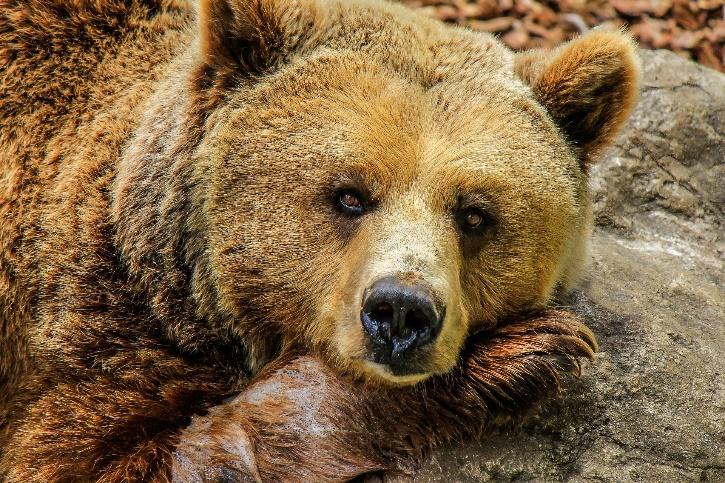
Ursus arctos
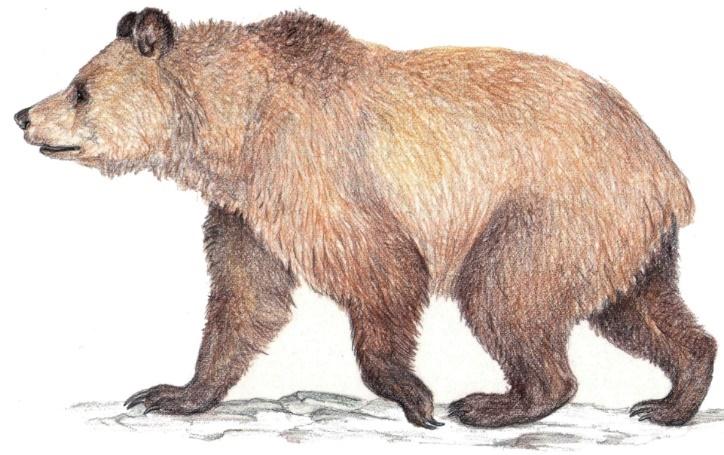
Ursus arctos
Until the end of the 19th century it inhabited all the mountains in Ludogorie. After the 1930s, it was preserved only in the Central Stara Planina and the Rila-Rhodope Massif.
Typical habitats of the species are coniferous and deciduous forests, usually above 600–1000 m above sea level, subalpine shrubs, rock massifs and gorges.
Females are sexually mature at 3-4 years, males at 5-6. Acceleration is most common in May-June. The female gives birth once every 2-3 years, mainly in caves, often around the upper edge of the forest. In our country only pregnant females have obligatory lethargy.
Negative factors on the species are isolation of both metapopulations; intensified poaching; urbanization in the mountains; anxiety; deforestation; feeding (changes the ecology and behavior of bears); late maturity and high mortality up to 3 years of age (up to 85%).
Occurs in North America, Palearctic Asia, Northern and Eastern Europe, the Carpathians. The Balkan Peninsula and several regions in Spain and Italy are inhabited by a genetically distinct, relict, Pleistocene population.

Canis lupus
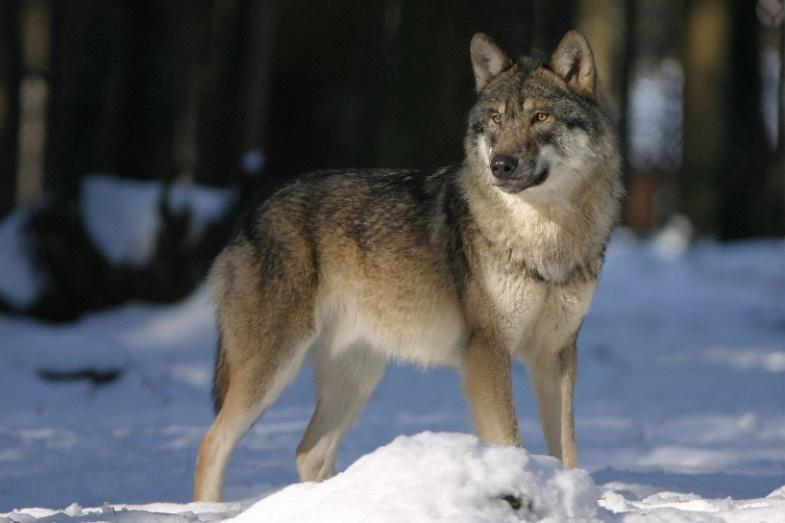
Canis lupus
In the early twentieth century it is found throughout the country. In 1965-1975, only 110-130 individuals remained. in 5 border zones. In the 1980s, expansion began due to a ban on predator poisoning and an increase in wild ungulates; number - 600-700 animals. During the breeding season it inhabits the mountains, partly Northeastern Bulgaria. Autumn and the middle of winter descend in the plains.
The characteristic habitats of the species are hard-to-reach mountainous areas with forests, bushes, rocks, gorges, meadows.
Monogamous species. Only the dominant pairs reproduce. Acceleration - January-February. The young, on average 4-6, are born in April. In September, the family (5-8 wolves) gathers for autumn-winter hunting. The main prey of the species are wild ungulates, sheep, carrion, dogs, goats, donkeys, etc.
Negative factors on the species are year-round hunting, reduction of food base, competition and hybridization with stray dogs.
Found in North America, Asia, Northern, Eastern, Southern, and partly Central Europe.
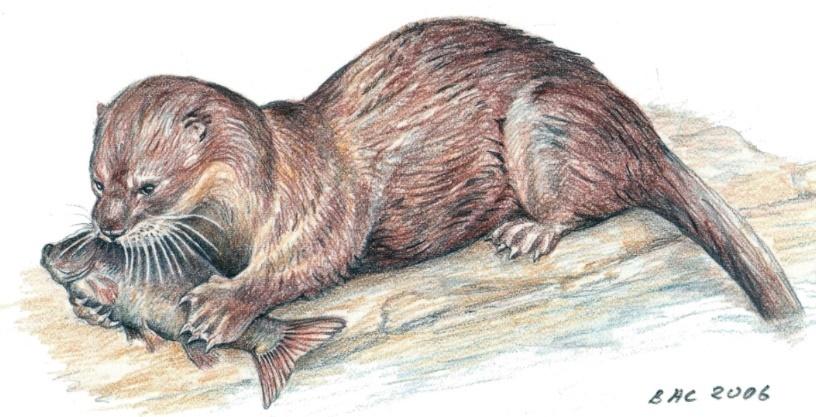
Lutra lutra

Lutra lutra
Until the 1930s, it was found almost everywhere; number of 4-5000 individuals, but in the 50's declining alarmingly. During the period 1970-1990 it increased its number to 800-1400 individuals. It is found in the plains, along the coast and in the mountains.
Habitats are characterized by natural river currents and closed reservoirs with a length of at least 15-20 km: with old trees and abundant coastal vegetation - longos, alders and reeds (low banks), diverse fish fauna and a minimum mass of 40 kg / ha , an abundance of crabs, frogs, vertebrates, mollusks.
The area of the male may overlap that of 1 or more females [4, 7, 9, 10]. The dens are at the roots of coastal trees. The young (2-4) are born in March-August (Survey, 1989) and follow their mother's year.
Negative factors on the species are dikes and river corrections, water pollution, fish reduction, swamp drying, deforestation and shrubbery. Water construction, gravel pits, poaching, vehicle accidents, fishing, fishing for stray dogs, disturbance, summer-autumn dry rivers.
The otter inhabits most of Eurasia and the Atlas Mountains.
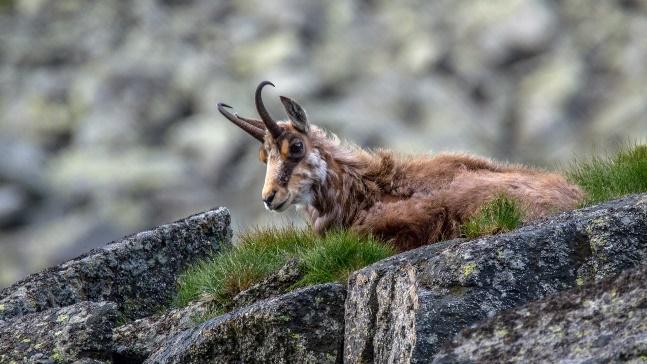
Rupicapra rupicapra<


Rupicapra rupicapra
In the past it inhabited Stara Planina, Sredna Gora, Vitosha and the Rila-Rhodope massif. From the end of the 19th century to the 1930s, it decreased menacingly, disappearing from Sredna Gora and Vitosha.
The characteristic habitats of the species are steep rocky slopes, forests and high mountainous forest-free zone.
Acceleration in Stara Planina is October-November, in Pirin - November-mid-December. Most females begin to reproduce in the third year, and males in the fourth and fifth. Pregnancy is 160-175 days; most often gives birth to 1 baby. In summer and early autumn, the female herds reach 40-50 animals. Eat during the day.
Negative factors on the species are hybridization with animals of the dominant subspecies, imported in 1977-1978 in the Rhodopes.
Probably the hybrid population of animals from the Rhodopes is also hybrid. Isolation of subpopulations, strong poaching, depopulation, urbanization, tourism concerns and packs of rabid dogs.
The species is a relic of ice age with 7 subspecies in the Alps, the Carpathians, the Caucasus, Asia Minor and the Balkans.

Spermophilus citellus
Spermophilus citellus
Occurs throughout the country, in the mountains up to 2500 m above sea level. Current data show a significant decline in the number and / or reduction of the inhabited area and its disappearance in some localities.
The characteristic habitats for the species are uncultivated lands (pastures, meadows, etc.), covered with low grassy vegetation, on homogeneous, poorly compacted water-permeable soils. It does not inhabit arable land, although it enters them for food.
Terrestrial species with daily activity. Forms intrapopulation local groups ("colonies"). The annual life cycle is clearly expressed: hibernation (hibernation), waking and mating, pregnancy and lactation, preparation for hibernation. It breeds once a year. Females give birth to 7 pups, rarely up to 9. They feed on green parts of herbaceous plants, bulbs, seeds, insects and rarely vertebrates. It occupies an important place in ecosystems as a food resource for all daily birds of prey and mammals.
Negative factors on the species are plowing of virgin lands and creation of large areas of arable land, construction, afforestation, direct persecution, successive changes in habitats due to the reduction of pasture cattle breeding and especially sheep breeding.
Occurs on the Balkan Peninsula, Central Europe (Pannonian Basin), isolated populations in Moldova, Ukraine, Germany (extinct), Poland (extinct).
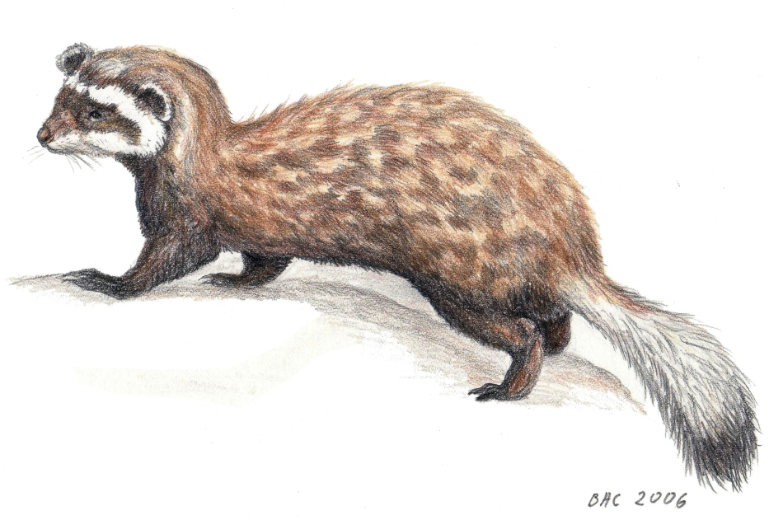
Vormela peregusna
Vormela peregusna
Inhabits mosaic plains, hollow fields, treeless terrains in semi-mountainous areas. It is more common in Northeastern and Southeastern Bulgaria and in the highlands of Western Bulgaria.
The characteristic habitats of the species are meadows, pastures, rocky terrains, desolate lands, including river valleys, dry valleys, canyons. Places with large colonial rodents are preferred.
Poorly studied species. Acceleration - mainly April-June; pregnancy - 8-11 months, giving birth to an average of 4-5 young from January to May. Females mature at 3 months, males at 1 year. Main prey - snipe, hamsters, blind dogs, mouse rodents, rarely frogs, reptiles, mollusks.
Negative factors on the species are the conversion of meadows and pastures into arable land, intensive agriculture (monoculture blocks, destruction of sinus, use of pesticides and fertilizers), reduction of the number of basic prey, fragmentation of habitats from transport corridors and road accidents, poaching.
From the steppes and deserts of East and Central Asia, including Mongolia and northwestern China, to the central and eastern Balkans, where the European V. peregusna peregusna inhabits , Southeastern Ukraine and Southern Russia.